
.jpg)








Challenges
- Unplanned Downtime: Mid-route failures causing network-wide delays.
- Maintenance Inefficiency: Unnecessary replacement of healthy components due to fixed schedules.
- Visibility Gaps: Lack of root-cause analysis for recurring fault patterns across different vendors.
- Inventory Strain: Inability to accurately forecast spare part consumption.
Solutions
Exponentia.ai delivered an end-to-end AI solution designed for high-velocity IoT data:
- Data Ingestion: Real-time streaming of telemetry (temperature, pressure, vibration) via Kafka.
- Data Lakehouse: Integration of maintenance history and fault logs using Talend and Apache Druid.
- AI Engine: Catboost Classification models for predicting failures in critical systems like traction motors and axles.
- Command Center: Qlik Predict dashboards providing failure probabilities and recommended maintenance windows.
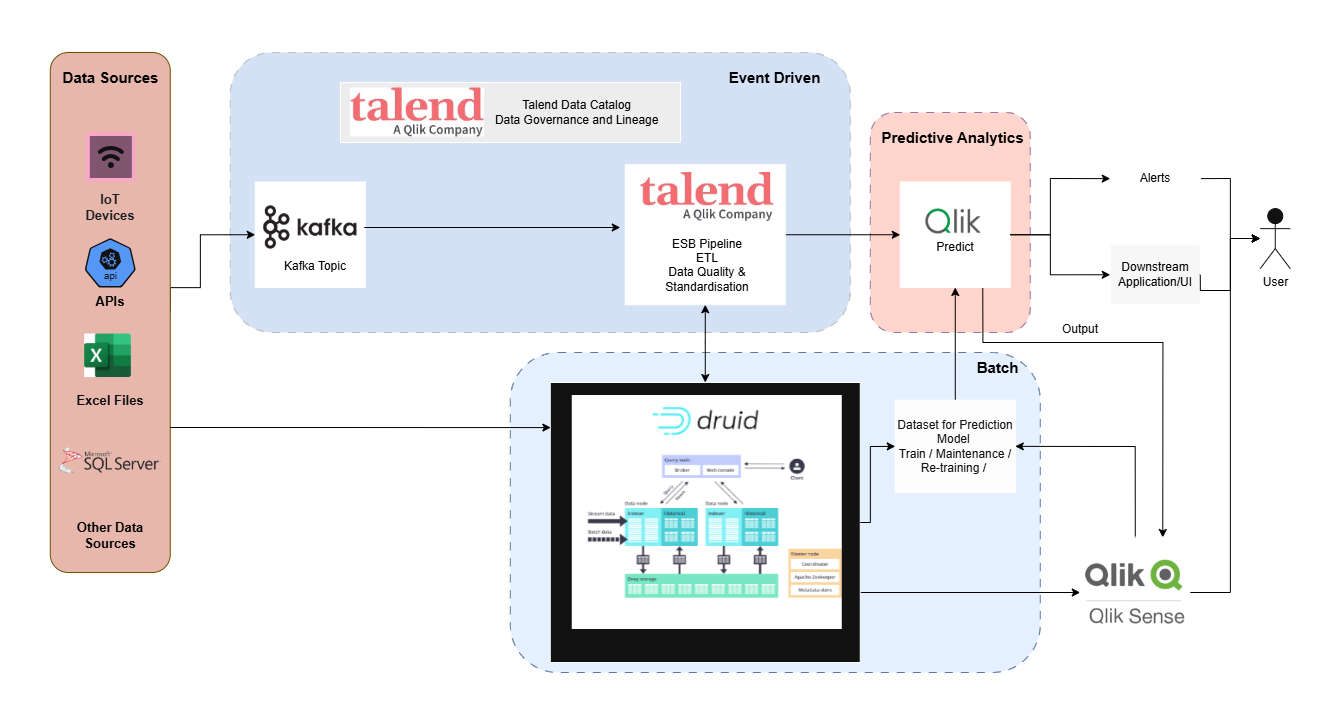
The architecture integrates real-time IoT ingestion from onboard sensors, stores and processes data in a high-performance analytics layer (Apache Druid), and enables predictive insights through AI models and interactive dashboards.
Technologies Used
- AI/ML: Catboost, Qlik Predict
- Data Ingestion: Kafka, Talend
- Storage/Analytics: Apache Druid
- IoT: Onboard locomotive sensors

Outcomes
- 30% Reduction in unplanned downtime.
- 15% Improvement in locomotive availability.
- 18% Savings in spare parts inventory costs.
- 8% Boost in network-wide punctuality.


.svg)

.svg)
.svg)
.svg)