










The archive represented more than a search problem.
Approximately 174.6 million duplicate records had been identified, while information existed across PDFs, Office documents, emails, ZIP archives, CAD/DWG assets and other formats. Some content could be extracted easily; image-based, encrypted, corrupt or specialist files required different processing strategies.
The solution therefore needed to provide:
Discovery across hundreds of millions of records
Search even when full-text extraction was unavailable
Multiple retrieval routes rather than dependence on a single AI model
Transparent ranking and match explanations for legal review
Controlled access to original source documents
Search, refinement and export workflows capable of operating at enterprise scale
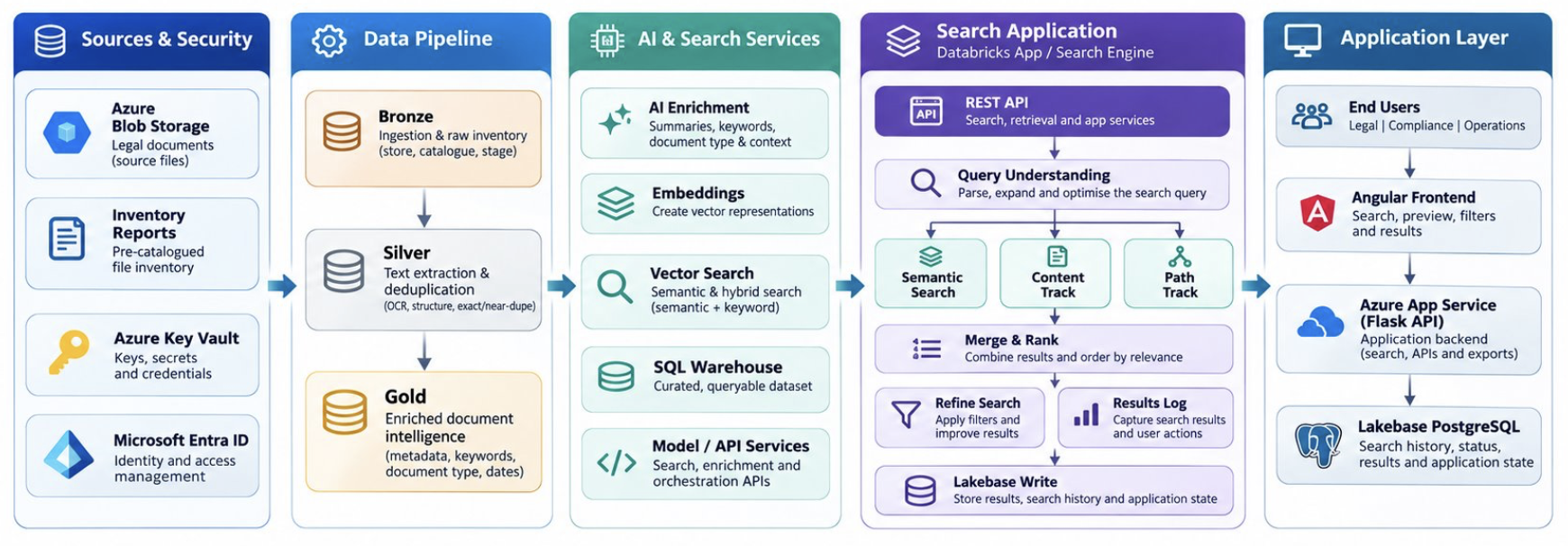
Exponentia.ai engineered a metadata-first, AI-enriched enterprise document intelligence platform.
Metadata-First Discovery
Source paths, file metadata, file types and identifiers were standardized before content enrichment. Links to original documents were preserved, allowing files to remain discoverable even where complete text extraction was unavailable.
Enterprise-Scale Data Engineering
A Bronze-Silver-Gold Medallion architecture separated inventory management, processing and enriched intelligence, helping make each stage independently manageable.
Hybrid Retrieval
The platform combined path-based, content-based and semantic retrieval, using Databricks Vector Search alongside conventional search techniques.
AI-Powered Enrichment
Documents were enriched with summaries, keywords, document classifications and contextual dates to improve searchability and relevance.
Explainable Ranking
Deterministic ranking and match explanations provided users with greater transparency into why particular documents appeared in their results.
Search-to-Evidence Workflow
Users could launch searches, refine results and export selected original documents. Large searches and export operations ran asynchronously, with result data retained independently from the interface.
Cost and Search Efficiency
The existing solution incurred high amount of cost for file storage on cloud. Also, the search method was manual and takes up to several weeks to search for relevant files.
Transformation
The project transformed a fragmented historical archive into an enterprise-scale discovery layer for legal knowledge.
Instead of relying on manual navigation, incomplete indexing or a single retrieval technique, legal users gained multiple ways to discover information across filenames, paths, extracted content and semantic meaning.
The architecture also separated AI-assisted discovery from the delivery of legal evidence. Search intelligence helped users locate relevant information, while original files remained the authoritative documents delivered through the export workflow.
This approach demonstrates what it means to engineer AI-native enterprise capabilities: combining data engineering, AI, application development, security and operational design into a production-ready business workflow.
520.3 TB archive estate made addressable through a unified search architecture
Approximately 285.5 million inventory records profiled
Approximately 174.6 million duplicate records identified
37.16 million files text-extracted
Approximately 36.75 million documents enriched
3 complementary retrieval strategies: path, content and semantic
Representative primary searches completed in 55–95 seconds
Representative refine searches completed in 21–52 seconds
Up to 10,000 ranked rows available in the interface while complete result sets remain preserved
Original documents available through controlled export workflows
Production deployment supported by documentation, training and operational handover


