







Delivering 80% Faster Processing and Up to 40% Cost Savings: A Scalable Data Ingestion & Catalog Framework on Microsoft Fabric

Challenges

Before implementing Microsoft Fabric, the health system faced significant technical and financial roadblocks:

  • Fragmented and Siloed Data Assets: Critical clinical, administrative, and research datasets were isolated across dozens of incompatible databases, legacy platforms, and flat-file networks.
  • Inability to Conduct Enterprise Reporting: Data fragmentation made it nearly impossible for teams to generate unified, cross-departmental reports, severely limiting systemic visibility.
  • High Maintenance Costs: Supporting and manually connecting dozens of siloed legacy architectures forced the organization to absorb unsustainable maintenance fees and infrastructure costs.
  • Delayed Decision Visibility: Operational and frontline clinical teams were left without real-time, consolidated insights, causing an informational lag that impacted strategic decision-making velocity.

Solutions

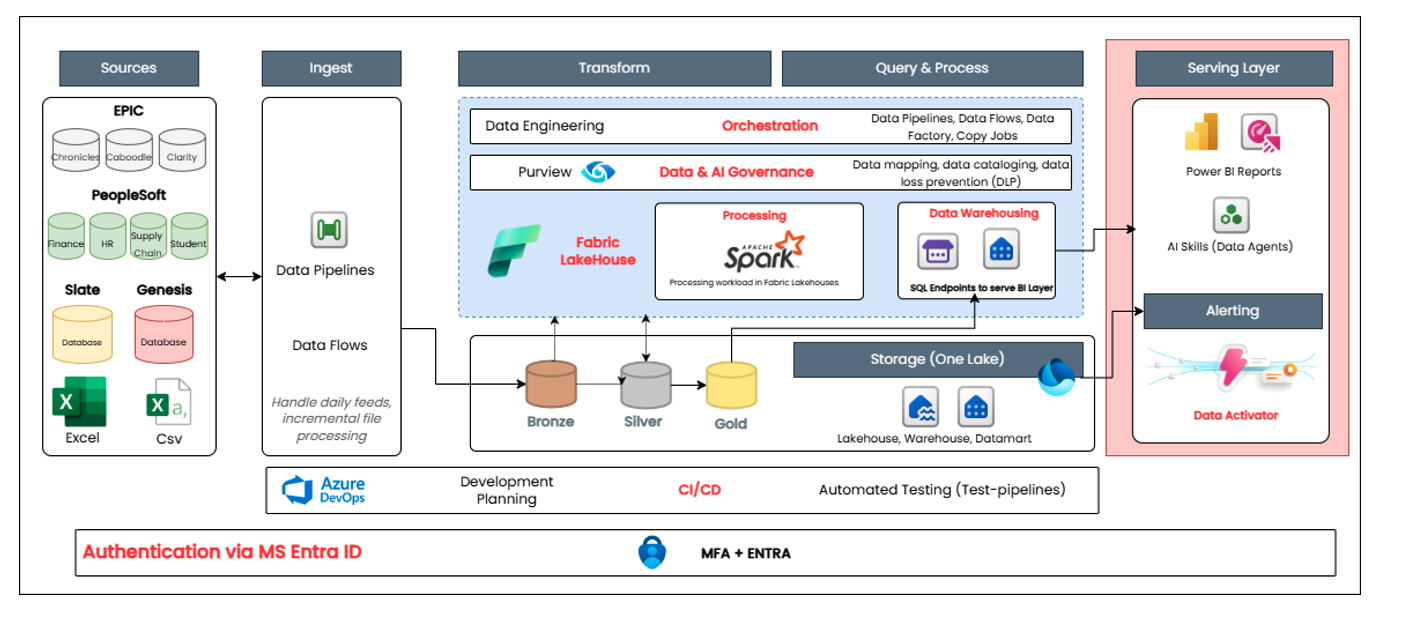
We engineered a unified, enterprise-grade data engineering platform leveraging Microsoft Fabric to consolidate billions of daily data points into a high-performance analytics repository.

The architecture eliminates fragmented data structures by introducing an automated, metadata-driven framework that refines data progressively while enforcing continuous governance. Key capabilities include:

  • Multi-Layered Medallion Architecture Established a standardized ingestion blueprint utilizing Bronze and Silver data layers. This structure systematically onboards and normalizes trillions of records across 15 critical business use cases, guaranteeing data quality and structural readiness.
  • Scalable Metadata-Driven Ingestion Built an incredibly flexible ingestion layer engineered to support diverse data handling patterns—including incremental, full-load, append, and overwrite processes—to accommodate variable source systems without custom recoding.
  • Enterprise Processing & Observability Controls Integrated built-in logging structures, operational monitoring dashboards, and concurrent processing engine models to maximize computational efficiency and data pipeline stability at scale.
  • Unified Microsoft Purview Governance Layered automated access controls, metadata schemas, and real-time data lineage tracking into the fabric environment to preserve strict compliance with healthcare regulatory guidelines.
Outcomes

The Microsoft Fabric deployment modernized the institution's data velocity, cost profile, and reporting capability:

  • 80% Performance Acceleration Query response times and complex data pipeline executions run 80% faster within the unified Fabric environment compared to the legacy setup.
  • ~40% Platform Cost Optimization Consolidating infrastructure onto Microsoft Fabric achieved an approximate 40% cost reduction compared to alternative environments like Databricks, drastically reducing total cost of ownership (TCO).
  • 35 Trillion Records Centralized Successfully extracted, structured, and loaded roughly 35 trillion records out of disconnected legacy environments into a single, high-performance Fabric lakehouse.
  • True Enterprise-Wide Decision Intelligence Eliminated departmental blind spots, providing clinical and business leaders with the accurate, real-time insights required to drive confident decisions across every hospital and clinic in the network.

Looking Ahead

By successfully consolidating one of the largest data footprints in the healthcare sector, this academic medical provider has established a world-class foundation for digital health innovation. Moving forward, this unified Microsoft Fabric infrastructure is positioned to accelerate the deployment of advanced AI applications, support real-time clinical predictive modeling, and significantly lower the time-to-insight for critical medical research initiatives.

Download

Download

Our Partners

Shaping the future with our trusted partners

explore

Explore

Explore

Contact

Reach out to us

Got a question, email us at - engage@exponentia.ai

Reach out to us

UK

US

Singapore

8 Eu Tong Sen Street #14-94,
The Central

India

Reach Out To Us

Name
Contact No.
Company Name
Company Email Address
Message
Thank you! Your submission has been received!
Oops! Something went wrong while submitting the form.

Delivering 80% Faster Processing and Up to 40% Cost Savings: A Scalable Data Ingestion & Catalog Framework on Microsoft Fabric

June 5, 2026
One of the largest academic health systems in the United States, managing an extensive network of hospitals, clinics, and research laboratories, partnered with us to execute a complete modernization of its data ecosystem. Deeply committed to clinical innovation and medical research, the institution discovered that its legacy infrastructure could no longer sustain the velocity and volume of modern health data. To resolve these complexities, we designed and deployed a comprehensive Data Ingestion & Catalog Framework built natively on Microsoft Fabric. This unified cloud platform scales to consolidate massive healthcare datasets into a single source of truth. By streamlining ingestion pipelines and implementing a governed Medallion architecture, the solution enables faster clinical insights, lowers overall technology costs, and supports enterprise-wide analytics at an unprecedented scale.
Challenges

Before implementing Microsoft Fabric, the health system faced significant technical and financial roadblocks:

  • Fragmented and Siloed Data Assets: Critical clinical, administrative, and research datasets were isolated across dozens of incompatible databases, legacy platforms, and flat-file networks.
  • Inability to Conduct Enterprise Reporting: Data fragmentation made it nearly impossible for teams to generate unified, cross-departmental reports, severely limiting systemic visibility.
  • High Maintenance Costs: Supporting and manually connecting dozens of siloed legacy architectures forced the organization to absorb unsustainable maintenance fees and infrastructure costs.
  • Delayed Decision Visibility: Operational and frontline clinical teams were left without real-time, consolidated insights, causing an informational lag that impacted strategic decision-making velocity.
Solutions

We engineered a unified, enterprise-grade data engineering platform leveraging Microsoft Fabric to consolidate billions of daily data points into a high-performance analytics repository.

The architecture eliminates fragmented data structures by introducing an automated, metadata-driven framework that refines data progressively while enforcing continuous governance. Key capabilities include:

  • Multi-Layered Medallion Architecture Established a standardized ingestion blueprint utilizing Bronze and Silver data layers. This structure systematically onboards and normalizes trillions of records across 15 critical business use cases, guaranteeing data quality and structural readiness.
  • Scalable Metadata-Driven Ingestion Built an incredibly flexible ingestion layer engineered to support diverse data handling patterns—including incremental, full-load, append, and overwrite processes—to accommodate variable source systems without custom recoding.
  • Enterprise Processing & Observability Controls Integrated built-in logging structures, operational monitoring dashboards, and concurrent processing engine models to maximize computational efficiency and data pipeline stability at scale.
  • Unified Microsoft Purview Governance Layered automated access controls, metadata schemas, and real-time data lineage tracking into the fabric environment to preserve strict compliance with healthcare regulatory guidelines.

Outcomes

The Microsoft Fabric deployment modernized the institution's data velocity, cost profile, and reporting capability:

  • 80% Performance Acceleration Query response times and complex data pipeline executions run 80% faster within the unified Fabric environment compared to the legacy setup.
  • ~40% Platform Cost Optimization Consolidating infrastructure onto Microsoft Fabric achieved an approximate 40% cost reduction compared to alternative environments like Databricks, drastically reducing total cost of ownership (TCO).
  • 35 Trillion Records Centralized Successfully extracted, structured, and loaded roughly 35 trillion records out of disconnected legacy environments into a single, high-performance Fabric lakehouse.
  • True Enterprise-Wide Decision Intelligence Eliminated departmental blind spots, providing clinical and business leaders with the accurate, real-time insights required to drive confident decisions across every hospital and clinic in the network.

Looking Ahead

By successfully consolidating one of the largest data footprints in the healthcare sector, this academic medical provider has established a world-class foundation for digital health innovation. Moving forward, this unified Microsoft Fabric infrastructure is positioned to accelerate the deployment of advanced AI applications, support real-time clinical predictive modeling, and significantly lower the time-to-insight for critical medical research initiatives.

Collaborating with Leading Technology Experts

Get in Touch

Exploring AI for your business? Drop your details, we’ll connect.
Thank you! Your submission has been received!
Oops! Something went wrong while submitting the form.
Contact Us Image
Need more information? Continue on Global Site